Unsurprisingly, no new wind farm applications have been lodged in Queensland since.
Australia has come a long way down the path to a renewable energy future. But it’s not yet job done. To complete the transition, we will need wind.
It’s not all bad news. Last week, a large new wind farm in Western Australia secured the necessary financing to go ahead. But more needs to be done.
Renewables now contribute more than 40% of the electricity generated in Australia’s main grid. Twenty years ago, that figure was under 10%. Despite this growth, the federal target of 82% by 2030 is slipping out of reach.
A transition well underway
Australia’s renewable slowdown isn’t uniform. Solar and batteries are going strong, while wind farms are struggling. This year, few new wind farms have reached the stage where construction could actually begin.
Overcoming these doldrums won’t be easy. But it has to be done. To do this, investors need certainty. That will mean giving clearer commitments to long-term climate policy at a national level.
Then there’s politics. In February last year, the Queensland government began requiring wind farm backers to do significantly more in terms of full impact assessments and public consultation. It also gave third parties more rights to appeal. In May, the state government axed the large, conditionally approved, Moonlight Ridge wind farm.
Huge change has already come to Australia’s power grids.
Once wind power is built, it becomes one of the most efficient and reliable sources of energy available. In windy areas, turbines can turn day and night.
This comes down to one reason: uneven investment. Australia is now the world’s third-largest market for grid-scale batteries, while solar farms are proceeding steadily.
Renewables aren’t collapsing – just wind
At present, these funds are thin on the ground. The 2026 survey by the Clean Energy Investor Group found the percentage of major investors rating Australia’s clean energy sector as “attractive” fell from 69% in 2025 to 58%, while the percentage regarding it as “somewhat unattractive” more than doubled from 8% to 19%.
Victoria’s Yallourn power station will close in 2028, while Australia’s largest coal plant, Eraring will close in 2029, after a two-year extension. Queensland’s Gladstone plant may be retired in 2029, six years early.
That’s a problem. Wind projects have to be financed years before they earn any revenue. On average, wind projects take over a year longer to be built than solar. These longer build times mean, with higher interest rates, these projects have higher upfront costs.
Projects that began under one set of policy assumptions can run into trouble if these change.
It’s common for wind projects to take about five years to become reality. If investors are reconsidering, Australia may not have enough clean energy in the pipeline to replace increasingly unreliable coal plants slated for retirement.
Why is wind tricky?
Economics pose another challenge. To be viable, wind farms need electricity prices above 0 per megawatt-hour. But the market is currently offering around .
If the present wind drought isn’t resolved soon, it will leave a large gap that won’t show up in energy statistics until it’s too late to fix.
Solar farms are typically smaller and faster to build. They’re also easier to finance in stages. Wind farms tend to be larger, take longer to plan and build and are harder to finance in stages.
But the clean energy rebuild isn’t done yet. An estimated A6 billion of investment will be needed by 2050.
Then there are construction costs, which have risen sharply in recent years. Turbine prices rose almost 40% between 2020 and 2022. Other challenges include the cost of new transmission lines, and a shortage of skilled workers.
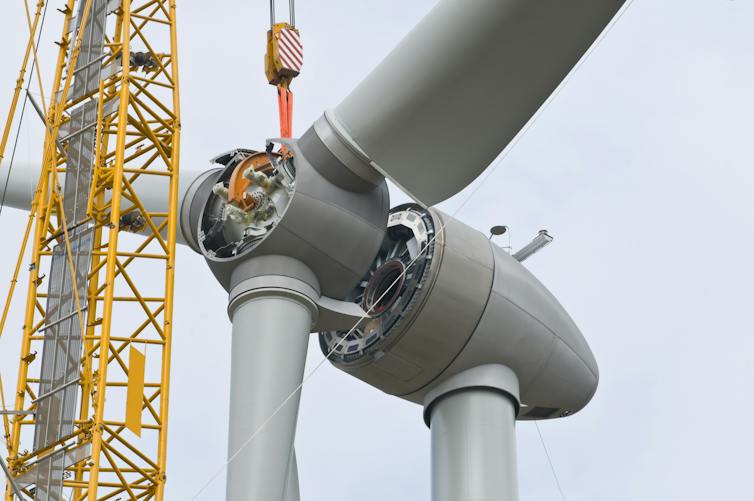
ZU_09/Getty
Wind has to be ready for coal to exit
But the real problem is wind. Supply chain shortages, financing issues, construction cost increases and political changes have made wind projects much more difficult to build. And that’s going to be a problem – Australia needs more wind projects to fill the gap as old coal plants retire.
But trade data shows Australia’s imports of battery storage roughly quadrupled between 2022 and 2025, while imports of wind turbines and equipment have fallen sharply.
Investors warn that the Coalition’s retreat from net zero threatens a recovery in confidence. The National and Liberal parties have ended their commitment to net zero.
Wind is crucial. The Australian Energy Market Operator is counting on wind to generate 47% of the total power from renewables in the main power grid by 2030.
Wind is key
This matches investment figures: in 2025, investment in batteries rose almost 70% to .8 billion, while wind investment fell almost 60% to .6 billion. Solar farm investment dropped a little, falling 5% to .9 billion.
More predictable state planning rules would help, as would allowing contracts to better reflect real construction costs.
If these worrying investment trends continue, wind will produce less power than authorities expected. Solar and batteries could take up some of the slack, but not all.
These three large plants produce about 30 terawatt-hours a year between them – roughly twice South Australia’s total annual power generation.