
The southern humpback whale migration is in full swing. Tens of thousands of whales are now making their journey from warm Australian waters in the north to their cold feeding grounds in Antarctica.
But snacking along the way provides much welcome replenishment.
In a new study, published in Marine Mammal Science, we have investigated feeding behaviour of humpback whales on the east coast of Australia using information from citizen science and social media. We found that mid-latitude feeding is a common and widespread strategy amongst humpback whales.
This discovery challenges a long-held assumption about where and when whales feed. And it could help us better protect these magnificent animals.
Feast or famine?
For many years, humpback whales have been described as “capital breeders”.
This theory suggests that the whales spend summer feeding on krill in Antarctica to build up fat reserves, then travel thousands of kilometers to low-latitude breeding grounds to mate and give birth. Warm tropical waters are nutrient poor, offering little opportunity to feed.
Historically, whaling and stranding records also supported this “feast or famine” theory, with the vast majority of humpback whales caught during mid-latitude migration in Australian waters having empty stomachs.
It was widely assumed that they relied solely on their fat stores to sustain their migration, mating, and the intense energetic demands of nursing newborn calves.
Screening the digital world for information
Conducting long-term, large-scale systematic research surveys across thousands of kilometres of the Australian coastline isn’t feasible due to the huge cost involved.
Instead, like other researchers turning to public photos and footage, we sourced information about feeding events from social media.
We searched platforms such as Facebook and Instagram for public posts from whale-watching companies, drone pilots, and dedicated whale enthusiasts. Only posts featuring clear visual evidence of defined feeding behaviour were included.
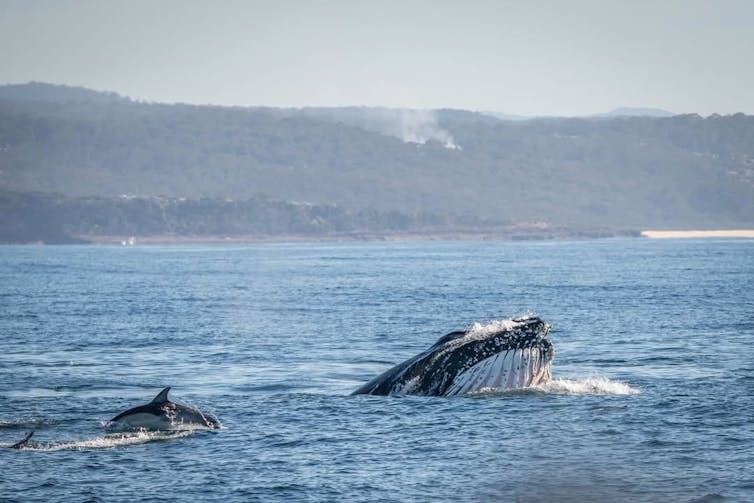
This included whales opening their mouths, lunging through the water column with expanded ventral pleats (the accordion-like grooves that cover a whale’s underside), bubble-net feeding, or surfacing directly through dense schools of baitfish.
Our search resulted in 199 distinct feeding observations, representing an estimated 1,417 individual humpback whales documented feeding in Australian waters between 2013 and 2024.
Major feeding hotspots included the NSW south coast – in particular, near Eden, Merimbula and Bermagui – which accounted for 45% of all verified feeding events. Other hotspots included eastern and southern Tasmania, and the Victorian coast, which accounted for 28% and 12% of the records, respectively.
Importantly, our study also highlighted feeding regions that were previously underrepresented in records. These included coastal areas near Phillip Island in Victoria and across northern Tasmania. We found that observations increased between August and October each year, coinciding with the southbound migration of humpback whales.
This is a time when the whales’ energy reserves are at their lowest.
Driven by nutrient-rich coastal upwellings generated by the East Australian Current, these hotspots provide temporary krill and baitfish bonanzas. On 16 occasions, we verified massive “super-groups” of 20 to over 150 individual whales feeding in the same area.
Peter Harris
Why these observations matter for whale protection
Understanding whale behaviour, and how it may shift over time, is critical to protecting them. Migratory corridors aren’t just highways from one place to another; they are critical habitats.
Unfortunately, these coastal feeding hotspots overlap with intense human activities.
Commercial fishing means humpback whales feeding and staying for prolonged time face a high risk of fishing gear entanglements.
Additionally, vessel strikes from commercial shipping lanes and acoustic disturbances from expanding offshore developments pose threats along the coasts.
We need to adapt whale protection management strategies.
This could mean implementing seasonal and mobile management areas with voluntary or mandatory ship speed reduction during peak feeding months. It could also mean changes to seasonal fishing regulations to reduce gear density and gear type.
Our research shows that such areas are dynamic but localised, with feeding intensity limited to only a few weeks each year.
As the humpback whale population continues its recovery from whaling, more eyes on the water will help us track how these magnificent creatures adapt to a fast-changing environment.


