
Copilot Workspaces is a collaborative environment currently available through Microsoft’s Frontier early-access program, but coming soon will be the ability to bring personal Autopilot agents into Workspaces. Early in the keynote address, Nadella said that “Until now, AI interactions have mostly been single-player. Workspaces makes it a truly multiplayer experience, where people and agents drive towards a common goal, with shared context.”
Governance over trust
Trust, the third pillar of Microsoft’s new frontier ecosystem, was something that Nadella continued returning to during his presentation, and not in a way that some might expect. “We find ourselves in a place where alignment is elusive. Mechanistic understanding of these models is elusive. The question is: How can you even trust all this powerful technology? The reality is, by definition, you can’t,” he said.
In a departure from the norms of “AI is magic” corporate hype sentiment, Nadella conceded that the internal workings of AI thought processes remain difficult to understand, and models cannot be trusted to govern themselves, regardless of whether their answers are accurate. Nadella described the solution as “an architectural imperative to separate the supply of intelligence” from the authority granted to it. Microsoft says each Autopilot agent will have a unique ID, and administrators can restrict permissions or block it entirely. All agent activities are logged for human review, and Autopilot can ask for human approval before engaging in certain actions.
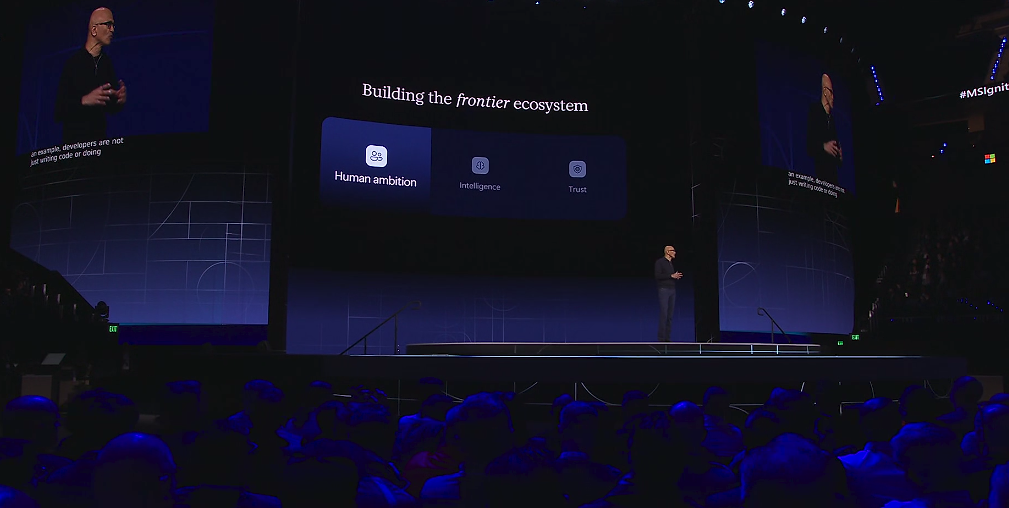
Human ambition, intelligence, and trust are said to be the three pillars of the frontier ecosystem.
Human ambition, intelligence, and trust are said to be the three pillars of the frontier ecosystem.
The promised agent controls and admission that AI systems can’t always be trusted are meaningful, but Microsoft is asking businesses and users to place their trust in the company’s own safeguards instead, though the effectiveness of those safeguards against mistakes, rogue actions, or data exposure will still have to be demonstrated. In Microsoft’s view, the solution to untrustworthy intelligence is not to make AI agents trustworthy, but to control what they’re permitted to do. Businesses will have to decide how much autonomy they delegate to agents.
Along with the guardrails, Microsoft announced what it calls the “AI Transparency Initiative.” The effort has partnered with 40-plus major companies, including Adobe and Mastercard, to develop open, industrywide standards for AI governance and security. Nadella described the initiative as a way for industry to “help establish an open standard that makes AI safer, more transparent, and more accessible.”


