
Certainly he never gave the impression of a writer with a burning passion to express himself, notwithstanding the “issues” aspect of songs like Smiley and the pseudo-mysticism of the album he wrote for Burns, Virgo.
Young had paid for Gibb to fly from Brisbane to Sydney for a television appearance, in the days when the Bee Gees were one more struggling pop band dying for a break.
Young’s masterpiece was Smiley, written about Normie Rowe’s induction into the army to serve in Vietnam, and recorded by Ronnie Burns.
John Pinkney, writing in the Melbourne Age on the program’s launch described Young’s compere approach as embodying “quiet, caressing sincerity”.
They didn’t chart, but Gibb took Young under his wing and gave him some tuition on songwriting. Young was not only an eager student, he applied his learning quickly with enormous success.
Johnny Young has died at 79 from pancreatic cancer, and Australian pop music has lost another of its multifaceted creatives of the ‘60s and ’70s.
He penned The Real Thing, which famously became a number one for Russell Morris. Embellished as it was with Molly Meldrum’s overblown psychedelia, is surely Young’s best known song.
Part of the skill of Smiley was that, while it did not bludgeon the listener with an anti-war message, nor did it leave anyone in doubt about how to feel: neither Rowe, or any other young Australian man, should have been fighting in the “Asian war”.
As a songwriter he could have gone from strength to strength, but writing was just one of the strings on his bow. He was a journalist, of sorts, writing a gossipy music column for the “teen and twenties paper” Go-Set; he was a radio DJ, in Melbourne and later in life in Perth; a TV host (starting with Club 17 and The Go!! Show) and he moved into television production with Kevin Lewis in the early 70s, beginning with the pop show Happening ‘70.
A cavalcade of up-and-comers cut their teeth on the program, many of whom continue to be household names. “YTT” was, much like Countdown, derided by many and watched by millions – and you knew there was a crossover between those two groups. The show lasted 18 years.
Crafting the hits
After that, if he performed at all, he seemed content to take on others’ compositions (most famously, a ballad arrangement of the Beatles’ All My Loving, which he first released in 1967).
Ross D. Wyllie’s exceptional The Star was a tale of loneliness-at-the-top as old as fame itself. It was also recorded by Herman’s Hermits in an inferior version which, nonetheless, made the UK Top 40.
Debuting in 1971, another Lewis–Young production, Young Talent Time was a brilliant format, combining a talent show with elements of 1960s pre-music video programs like Uptight and Bandstand: the stars you loved performed the hits you knew.
He did bring many of his own compositions (not The Real Thing) together on one tepid LP, The Young Man and His Music, in 1973, and performed them in a way that suggested he found them foreign and absurd.
But Barry Gibb taught the man to fish.
Young returned to Perth in the 21st century for a long and successful career as a radio announcer on a range of stations.
A ‘quiet, caressing sincerity’
Meldrum would go on to augment The Real Thing with Hitler speeches, choirs and the atom bomb to make what could either have been an iconic masterpiece or an embarrassing, costly folly. Luckily, it was the former.
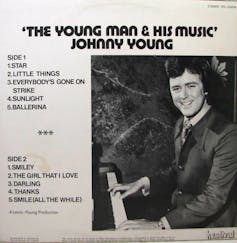
Ebay
Perhaps his self-effacing nature goes some way to providing the key to this unusual, talented, fortunate man.
That Young essentially stopped writing songs and, therefore, making hit records, in the early 70s is mysterious.
Three more chart-toppers marked Young as a songwriter to rival the best of his era.
Read more:
All my loving: Young Talent Time still glows, 50 years since first airing on Australian TV
While there may be different assessments of Young’s legacy, it’s undeniable he made a major impact on this country’s musical and television landscape.
In London, in 1967, Young was poised to enter the British hit parade with covers of the Bee Gees’ Craise Finton Kirk and Every Christian Lion Hearted Man.
Young also wrote and produced the magnificent Hello for Normie Rowe: a love song that, in the hands of this great pop performer, ranked with the best “sunshine pop” of the period.
While he was known for his integrity and honesty, one statement Johnny Young made well into the flush of his pop success is easily challenged. In 1968, he told Go-Set: “I was not talented, just fortunate”.
John de Jong was Dutch-born and raised in Kalamanda, in the hills of Perth. As a pop singer he was an early beneficiary of the generosity of the first wave of Australia’s international pop sensations: the Easybeats’ George Young and Stevie Wright wrote him a hit single, Step Back.
The story of Meldrum wrestling the demo of The Real Thing (originally intended for Ronnie Burns) from Young to turn it into the debut solo record for Morris, his protege, is as legendary as the story of Meldrum soundlessly gesturing to backing band, The Groop, in the studio to keep playing the rudimentary track for minutes beyond the time they’d rehearsed.
Young wrote a jaunty country ditty, I Thank You, to order for Aboriginal boxer Lionel Rose: it made the top 20 in early 1970.


