Some have argued the project represents a coming-of-age moment for Auckland – a step toward embracing its identity as a genuinely metropolitan city.
For infrastructure to be enjoyed, valued and, above all, used by a city’s residents, it needs to embrace more than bare utilitarianism.
As former Auckland Transport chief executive Dean Kimpton observed, New Zealand infrastructure can sometimes feel “too understated” compared with major world cities.
Another local example of the success of this approach is Christchurch’s Tūranga library, a site of major civic pride. Such strength of feeling would not have coalesced around a large shed housing the city’s book collection.
But what is almost as remarkable is that the City Rail Link project (jointly owned and funded by central and local governments) has also delivered impressive public spaces. Auckland’s new stations – two brand new and one substantially refurbished – go well beyond the functional minimum.
The unveiling of the architecture, design and public art associated with each station has attracted attention far beyond the typical audience for transport projects.
They’re like cathedrals. You only have to catch a bloody train. You don’t have to get married there.
After nearly a decade and with a budget of NZ.493 billion, expectations for Auckland’s City Rail Link are high ahead of its September 13 opening.
For decades, Auckland suffered from a peculiar form of civic hesitancy. It wanted the advantages of a major city but often felt uneasy about building infrastructure, public spaces and the civic ambition required to realise them.
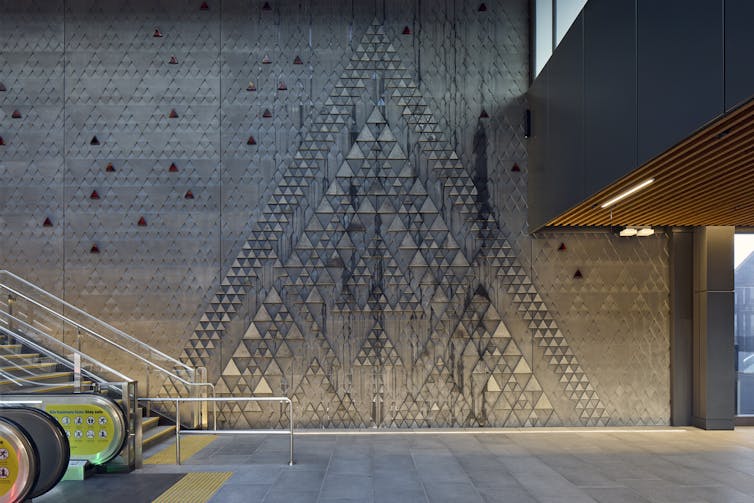
Auckland Transport, CC BY-NC-ND
Libraries could be simple sheds full of books, for example. Parks could be empty grass fields. Museum collections could be stored in warehouses. Yet many cities invest in making these places memorable because public spaces do more than fulfil practical needs.
The twin 3.45-kilometre tunnels, which will expand the central city’s public transport options and optimise the surrounding rail network, is a transformative piece of infrastructure. That alone is significant.
People are not simply discussing train frequencies and platform layouts. They are discussing public services, infrastructure, and civic design and identity.
The sentiment is perhaps understandable in the context of rising council costs, debts and rates increases. Why spend money making infrastructure beautiful when it only has to work?
There are virtues in this approach. Public money should be spent carefully. Infrastructure should serve people before it serves architects.
This has often extended to urban infrastructure, which has tended toward adequacy over aspiration, efficiency over inspiration.
There may be deeper cultural forces at work, too. For generations, New Zealanders have celebrated practicality, frugality and the “number 8 wire” mentality. We admire ingenuity and making do with what we have.
But not everyone has come away loving what they saw. Auckland Mayor Wayne Brown, for one, questioned the project’s design ambitions after visiting the stations:
Images and videos released so far have generated genuine excitement. In August, thousands flocked to public previews at the Mangawhau, Te Waihorotiu and Karanga-a-Hape stations – enough people to fill Eden Park.
Or, as public transport advocacy group Greater Auckland put it after the unveiling of two new public art pieces outside midtown station Te Waihorotiu, “We can have beautiful things!”
Civic infrastructure expresses collective values about what a city thinks its inhabitants deserve. This is why the debate around the City Rail Link feels bigger than being just about trains.

Auckland Transport, CC BY-NC-ND
You do not need a cathedral to catch a train. But cities are at their best when they occasionally build things that remind people they are part of something larger than the daily commute.
The enthusiasm surrounding the City Rail Link suggests that mood may be changing.
But a city is not simply a collection of utilitarian engineering solutions. Great cities are full of places that exceed pure functionality.
Public response so far suggests Aucklanders are not merely interested in shorter journeys and increased rail capacity. There is a sense of excitement and curiosity, perhaps even pride.