
If that sounds expensive, consider that a single major hurricane season can cost the United States hundreds of billions of dollars, while marine heatwaves have already collapsed fisheries and triggered mass coral bleaching around the world.
The total annual cost of operating the GOOS – across all platforms and personnel worldwide – is on the order of US.1 billion (about NZ.8 billion).
Underwater gliders target eddies, coastal currents and continental margins where floats cannot go. Elephant seals fitted with sensors collect data beneath polar sea ice in regions no other instrument can easily reach.
Each of these platforms answer questions the others cannot. And ocean observations collected by them now underpin many of the forecasting systems that modern societies rely on every day.
The hidden system behind modern forecasting
The same is true for hurricane and cyclone forecasts, as well as seasonal forecasting used to anticipate drought, harvests and energy demand. Marine heatwave warnings, sea-level projections and efforts to understand major current systems also rely on sustained long-term observations beneath the ocean surface.
That would require a rebuild of the system which would prove much more difficult and expensive than the cost of sustaining it today.
In short, the GOOS underpins everything from tomorrow’s storm warnings to next century’s climate adaptation plans.
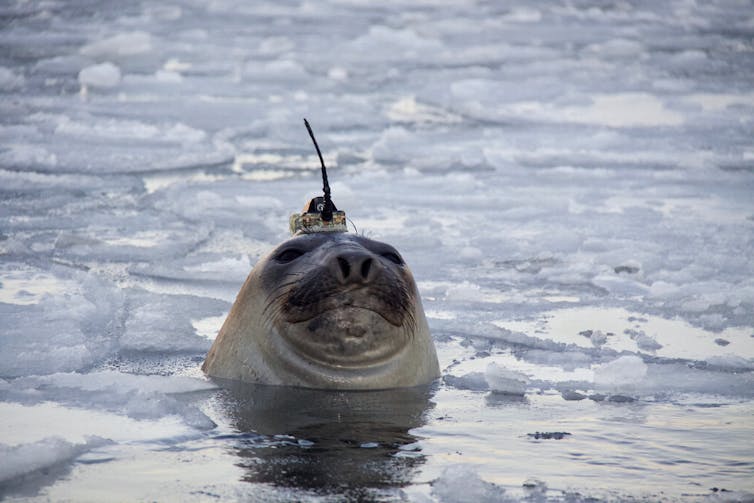
C McMahon/IMOS, CC BY-NC-ND
In China, scientists and policymakers are trying to build a more resilient national observing effort – but without the resources currently required to fully support it.
The international scientific conference OceanObs’29, to be held in China in three years’ time, will be an opportunity to negotiate a more balanced global observing system – one better aligned with today’s economic realities and maritime interests.
The GOOS is often described as a form of climate monitoring – but it is much more than that. It can best be understood as a network of complementary observing systems, each designed to capture different parts of the ocean in different ways.
New Zealand plays a surprisingly important role here. Since 2004, the research vessel Kaharoa has helped deploy more than 1,100 Argo floats for international partners across the Pacific and Southern Ocean.
It should also encourage greater scientific cooperation among countries, helping ensure complementary observing networks collectively cover as much of the global ocean as possible.
Some 4000 autonomous Argo robotic floats sink every ten days down to 2000m depth, before rising to the surface to transmit temperature and salinity profiles to ground stations via satellite.
Elsewhere, observing systems are also under growing strain, with European programmes facing mounting funding pressure.
These observations are key for monitoring El Niño climate patterns – including a major event already underway and likely to peak late this year – and major current systems such as the Atlantic Meridional Overturning Circulation.
More importantly, it could leave the world flying blind into the most consequential transformation of the planet’s climate in human history.
Yet our newly published analysis suggests the system delivering those observations is far more fragile than most people realise.
But now there is rising concern this system itself is at risk – just when the world needs it most.
These new insights are made using a vast global network of instruments – from drifting floats and moored buoys to research vessels and underwater gliders – that quietly and continuously feed data to scientists.
A resource the world can’t afford to lose
The author acknowledges the contributions of Sabrina Speich, John P. Abraham and Lijing Cheng to this article.
At the same time, if any one component of the GOOS is removed because of political decisions made in the US or elsewhere, the whole system’s ability to deliver reliable information would degrade.
Maintaining that coverage requires constant renewal.
Compared with the economic damage linked to ocean-driven extreme weather and climate disruption, ocean observation is one of the highest-return public investments available.
We found that if observations from a single major contributor, the United States, were withdrawn from GOOS, errors in estimates of how fast the ocean is warming would jump by 163% – worse than randomly losing 80% of all global ocean data.

M.Naumann/IOW, CC BY-NC-ND
Increasingly, the world’s oceans are telling us our climate system may be changing faster and more dramatically than expected.
The reason is largely geographical: US instruments cover every ocean basin and fill critical gaps no other nation currently monitors.
This demonstrates that even smaller countries can use their institutions, expertise and maritime interest to make important contributions.
And this is no theoretical concern. Proposed cuts to the National Oceanic and Atmospheric Administration (NOAA) and the National Science Foundation in the United States now threaten exactly this contribution.
Known as the Global Ocean Observing System (GOOS), it provides the fine-grained data that scientists need to detect changes, test climate models and refine projections of future risk.
That includes the numerical weather models used to generate daily forecasts, which continuously ingest ocean data to predict evolving weather conditions, as well as newer artificial intelligence-based forecasting systems.
Argo floats typically last four to five years before their batteries fail. This means they must continually be deployed to prevent gaps emerging across the oceans.
While satellites can measure surface conditions, they still cannot directly observe the deeper waters where heat accumulates, currents reorganise and the precursors of future weather are already forming.


