
Every version showed the freshening through 2015, then a sharp reversal to saltier, denser, deeper water from 2016 onward. The change was strongest in the South Atlantic.
In the bigger picture, these changes emphasise the need for rapid, sustained cuts in greenhouse gas emissions to limit further warming and give Antarctic sea ice a better chance of recovery.
Antarctic intermediate water travels from near Antarctica out of the Southern Ocean and into the subtropics of the Atlantic, Pacific and Indian oceans. It forms part of the bigger circulation system of the world’s oceans.
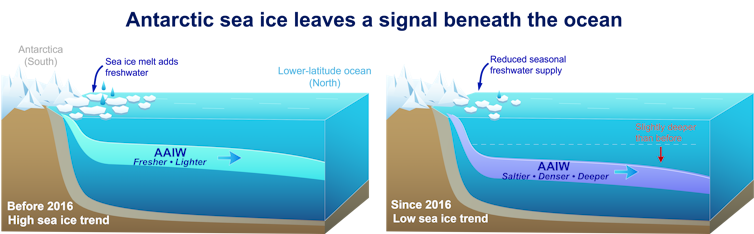
The water forms a layer called the Antarctic intermediate water, which sits around 700 to 1,200 metres beneath the surface. It forms a barrier that limits how much surface waters can mix with the deeper body of the ocean – and how much heat absorbed at the surface can move into the depths.
Kaushik Mishra, CC BY
Why should we care?
We don’t know whether this reversal marks a lasting shift in the Southern Ocean. It is possible the freshening trend could return in the near future.
Other parts of this system, such as the Atlantic’s overturning circulation, are also showing signs of change. Overall, we see that the ocean is changing faster than expected as the world gets hotter.
To make sure the observed changes were real, we drew on 20 years of data from the Argo programme. This is a global fleet of robotic floats that drift through the ocean measuring temperature and salinity, beaming the results back by satellite each time they surface.
The end of a predictable rhythm
We also need to figure out what this reversal means for ocean circulation and heat storage. Following the changing properties of Antarctic intermediate water as it spreads northward will help reveal how far the effects reach and whether they influence how the ocean exchanges heat with the atmosphere.
For decades, the seasonal cycle of sea ice freeze and melt made the Antarctic intermediate water a little fresher and a little lighter than the year before.

Kaushik Mishra, CC BY
Things are happening much faster this time. Earlier shifts unfolded over centuries or longer, rather than in a single decade.
This pattern held from at least the 1970s through 2015. But in 2016, a dramatic decline in sea ice changed everything. The seasonal meltwater supply collapsed, and the trend it had sustained for decades reversed within a matter of years.
The ocean already holds more than 90% of the excess heat added to the climate system by rising greenhouse gases. Where that heat ends up will shape how the climate changes over the coming decades.
What we did
To find out, we will need more observations. Programmes such as Argo allow us to track changes beneath the ocean surface which let us find out what are temporary fluctuations and what are persistent shifts. Keeping these measurements going will be essential to understanding what happens next.
We built three independent versions of the ocean record from the Argo data. Then we checked all three against satellite sea-ice observations and separate studies of ocean conditions from 2004 to 2024.
Reversals like the one we’ve now measured have happened before. Similar shifts show up in ocean sediment records from the end of past ice ages, tied to major changes in Antarctic sea ice deep in the geological past.
What’s next?
For as long as we’ve had reliable measurements, the Antarctic intermediate water has been growing steadily lighter and fresher. But in 2016, sea ice levels around Antarctica began to plummet.
Our new research shows that over the past decade, the Antarctic intermediate water has rapidly become saltier and more dense, and sitting deeper in the ocean. As a result, more heat may reach the deeper waters – with unknown consequences for the world’s climate.
Antarctic intermediate water forms when sea ice melts each spring and summer, freshening the surface layer. Winter cooling and mixing also shape this water mass, which then sinks beneath the surface and spreads north into the Atlantic, Pacific and Indian oceans.
Every southern spring and summer, sea ice around Antarctica melts with the change of season. The melt injects fresh water into the sea, where it mixes and sinks, then slowly spreads northward into the Atlantic, Pacific and Indian oceans.


