Picnic at Hanging Rock remains powerful today, especially in light of ongoing discussions about Indigenous sovereignty and reconciliation in Australia. The film’s mystery is never solved, forcing viewers to sit with the discomfort of what’s left unsaid.
The girls represent white femininity, meant to bring culture and control. When they vanish, it’s as if the land rejects these colonial ideals.
Based on Joan Lindsay’s 1967 novel, the story captured the public imagination with its haunting beauty and unanswered mystery. Audiences were obsessed with whether it was based on true events (it wasn’t).
Russell Boyd’s cinematography is key to the film’s unsettling mood. Shifting light and strange angles create a sense of uncertainty. The bush isn’t just background, it is defiant. This fits with “ecological cinema”, where nature has its own voice.
Unease and ambiguity
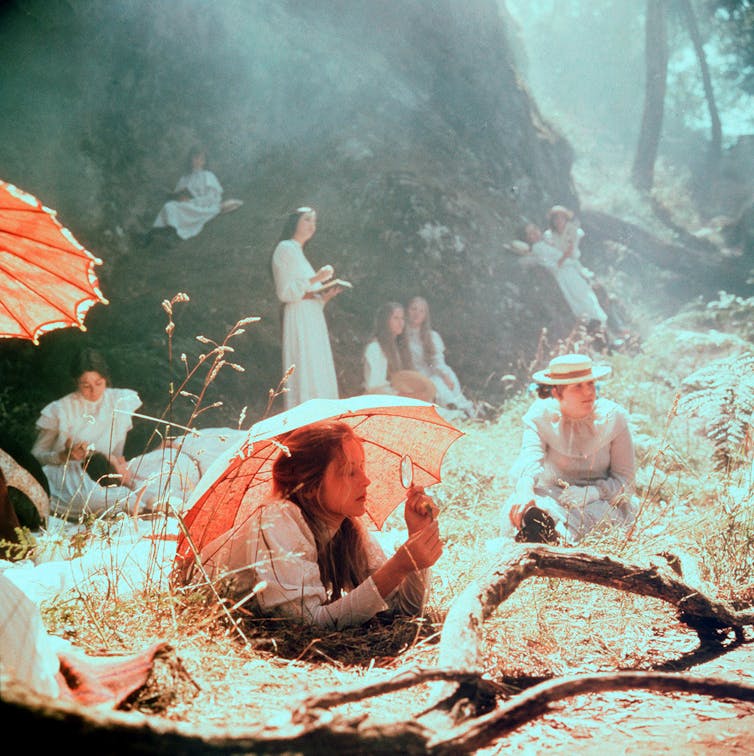
Picnic at Hanging Rock tells the story of a group of private schoolgirls and their teachers who visit the nearby Hanging Rock on Valentine’s Day in 1900. During the excursion, three students and one teacher mysteriously disappear.
The land is not something empty or passive, but alive. It is a force that remembers and resists.
While the film appears dreamlike and mystical, Ngannelong’s sacredness challenges this romantic view, reminding us that the land holds its own stories and history.
Australia’s national identity rests on silences and erasures. Like the missing schoolgirls, the colonial subject is lost – unsure of who belongs and whose history matters.
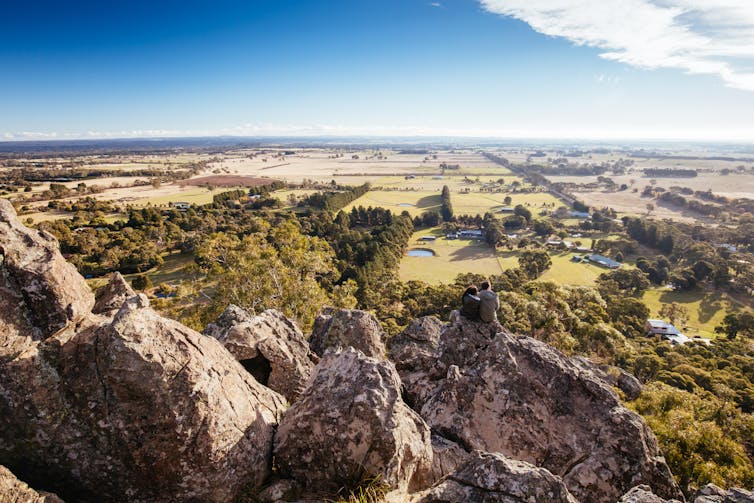
Ngannelong, also known as Hanging Rock, is a striking volcanic formation north-west of Melbourne. For the Dja Dja Wurrung, Woi Wurrung and Taungurung peoples of the Kulin Nation it is a deeply important cultural and spiritual place.
Picnic at Hanging Rock can be seen as a powerful story about colonial fear and uncertainty. The unexplained disappearance of the schoolgirls plays off the idea that European thinking and logic can’t fully understand or master the Australian landscape.
The mystery of the landscape
Peter Weir’s Picnic at Hanging Rock, released 50 years ago, is remembered for its eerie atmosphere and mysterious story. But beneath its haunting beauty, the film challenges the idea of colonial control over the Australian landscape.
Their disappearance unravels the school’s order, exposing how fragile colonial power really is. It hints at a deeper crisis beneath the surface.
With its poetic visuals, haunting score and colonial setting, the film stood out for its mood rather than action. Audiences were both fascinated and frustrated by its lack of closure, and it gained a cult following, especially among viewers drawn to its gothic atmosphere and slow-burning mystery.
Even 50 years later, the film still unsettles, not just through its eerie beauty, but by challenging colonial ways of thinking and reminding us that sovereignty endures – even if it’s not always visible.
FiledIMAGE/Shutterstock
The rock becomes a place that refuses to be explained or conquered by European logic.
Lindsay and Weir’s mystery of white schoolgirls who mysteriously vanish sits on top of older, deeper traumas – those of dispossession and the forced removal of Indigenous people from their lands.
Fragile powers
This tension between the land and colonial power still matters today. The failure of the referendum on the Indigenous Voice to Parliament shows how divided Australia remains over questions of reconciliation and Indigenous sovereignty.
It does not forget.
As the search for answers continues, the film refuses to provide resolution, deepening its sense of unease and ambiguity.
Picnic Productions Pty Ltd./AAP Image
The film contrasts the tidy world of Appleyard College – which stands for colonial order, built on white privilege and Britishness – against the untamed mysterious landscape of Ngannelong.
Picnic at Hanging Rock is part of the Australian Gothic: literature and films which explore dark parts of Australia’s story. Named for European Gothic literature of the 18th and 19th centuries, these 20th century Australian stories often express the anxieties, violences and uncanny dislocations of colonisation and the natural landscape these settlers encountered.
Historical wounds
In Picnic at Hanging Rock, the land often overpowers people. It refuses to be controlled or explained by colonial ideas.
When watched through this lens the story reveals just how fragile colonialism is. The film invites viewers to think differently about Australia’s identity, suggesting the landscape itself remembers the past and actively resists the stories colonisers have tried to tell about it.
No clear explanation is ever given, which unsettles both the characters and the audience. The mystery triggers hysteria, scandal and a slow collapse of order at Appleyard College.
The film became a landmark of the Australian New Wave, a 1970s movement that revitalised the national film industry with bold, artistic storytelling and a focus on uniquely Australian themes.
In this Australian Gothic tradition, Picnic at Hanging Rock uses haunting and mystery to explore deep social and historical wounds. These unsettled feelings still shape how Australia sees itself.
Rewatching Picnic at Hanging Rock in 2025, we can appreciate the film as an unsettling portrayal of place, silence and disappearance.