
That means eating plenty of fruit, vegetables, wholegrains and other fibre-rich foods, as well as limiting intake of red and processed meats (such as hotdogs and cured meats). Limiting alcohol intake is also advised.
We used data on eating frequency and portion size to estimate the daily amount of ultra-processed food each participant usually consumed.
The food frequency questionnaire was not designed to assess processing. So, we evaluated how well the questionnaire measured ultra-processed food intake in a subset of participants who provided detailed information on everything they consumed.
As with any questionnaire-based study, caution is required in interpreting results. Also, our study only found associations, and cannot establish cause and effect.
Group 2 contains processed culinary ingredients, including oils, butter and sugar.
Group 1 contains unprocessed or minimally processed foods. It includes raw fruits and vegetables, seeds, eggs, milk, and unprocessed meat such as steak.
Choosing wholegrains and limiting processed meat aligns with current evidence-based guidance.
A complex picture
Overall, our findings support current dietary guidance for bowel cancer prevention.
Higher intakes of wholegrains, fibre, dairy, and calcium and lower intakes of processed and red meat have been associated with lower bowel cancer risk.
Overall, our findings suggest the label “ultra-processed” alone doesn’t tell the full story about bowel cancer risk. What’s in the food seems to matter.
Group 3 contains processed foods that are made by combining items from groups 1 and 2. This includes things such as vegetables preserved in brine and whole fruit preserved in syrup, as well as home baked breads and cured meats.
What we did
Participants were followed for cancer incidence for more than 20 years, and more than 10,000 bowel cancer cases were diagnosed.
That said, intake of wholegrains, fibre, dairy, and calcium from ultra-processed food sources was associated with lower bowel cancer incidence. Eating ultra-processed meats was associated with higher bowel cancer incidence.
Participants answered questions about demographics, health conditions, and lifestyle factors, including smoking, physical activity and dietary intake.
Still, our findings suggest we should be cautious about drawing conclusions about ultra-processed food as a whole group. The type of ultra-processed food you eat may also be important, when it comes to bowel cancer risk.
To find out more, we looked to a large data set from the US.
We analysed data from over 460,000 US adults who were between the ages of 50 and 71 and cancer-free when they enrolled in the NIH-AARP Diet and Health Study in 1995-96.
Prior studies evaluating the association between ultra-processed food intake and bowel cancer risk have been inconsistent. Some have found that higher intake is associated with higher bowel cancer incidence, while others have found no association.
Researchers and policymakers should avoid treating all ultra-processed foods as one group as this may mask differences linked to disease risk.
QIMR Berghofer Medical Research Institute
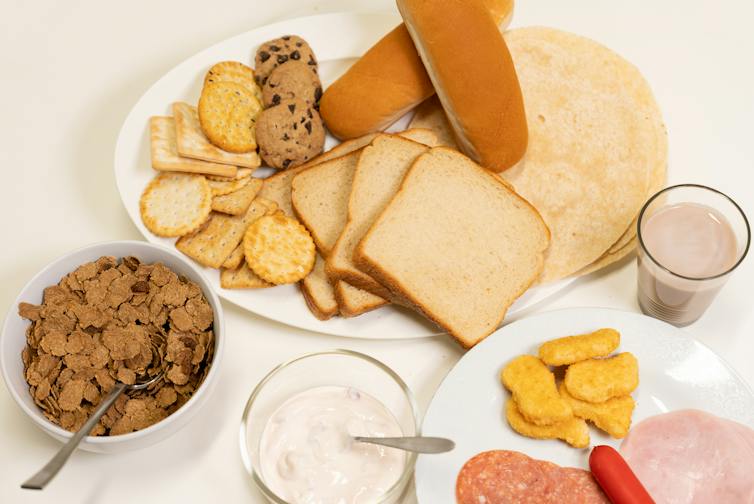
Ultra-processed foods includes things such as store-bought biscuits, instant noodles, sugary drinks, processed meats and chips.
Replacing 10% of your intake of ultra-processed foods with minimally processed foods is linked with 2% lower incidence of bowel cancer, according to our new analysis of data from more than 460,000 US adults.
However, we also found no association between total ultra-processed food intake and bowel cancer incidence.
We used statistical models to estimate associations between ultra-processed food intake and bowel cancer incidence. We accounted for demographic, lifestyle and health-related factors, including physical activity, smoking and drinking alcohol.
We also estimated associations for key dietary factors (dairy, wholegrain, meat) from ultra-processed and non-ultra-processed sources as well as Nova-defined ultra-processed food subgroups.
What we found
Importantly, these food groups and nutrients are in lots of foods, from minimally processed to ultra-processed (as defined by the Nova classification system).
- higher intake of reconstituted meat products, such as hotdogs, was associated with higher bowel cancer incidence
- higher intakes of frozen desserts and milk products, such as fruit yoghurts, were associated with lower bowel cancer incidence
- higher intakes of breakfast cereals and bread were also associated with lower incidence of bowel cancer
- replacing 10% of ultra-processed food intake with the equivalent weight of minimally processed foods was linked to a 2% reduction in the incidence of bowel cancer.
Group 4 contains ultra-processed foods, which are created using ingredients, like synthetic emulsifiers, or techniques (such as extrusion) that aren’t available to home cooks. This include things such as soft drinks, packaged snacks, mass produced breads, fruit yoghurt, hotdogs and ready-to-eat meals.
We found that:
We found that intake estimates lined up closely. This indicated that the questionnaire captured ultra-processed food intake reasonably well.
We defined ultra-processed food using the Nova classification system. This system assigns foods and beverages into one of four groups according to the nature, extent, and purpose of industrial processing:


