
Scientists are increasingly worried we may be witnessing the start of the “sixth mass extinction” – the first to be caused by human activities.
Five earlier mass extinctions, caused by dramatic but natural events, have devastated life on Earth during the past half billion years.
The most famous, though not the largest, was triggered by an asteroid impact 66 million years ago and caused the demise of the dinosaurs – with the exception of a feathered, meat-eating group that continued to evolve into modern birds.
Today, the rapidly increasing rate of human-caused extinctions is one of our greatest challenges.
To slow these accelerating rates, we need to understand and minimise the factors that raise extinction risk. But therein lies a problem. Although predictable to some extent, extinction is subject to fickle outcomes and can only be truly understood in hindsight, when it is too late.
For example, the spectacularly abundant passenger pigeon in North America – likely the most abundant bird on the planet at the time – was driven to extinction within a few decades during the 19th century.
In contrast, the tuatara persisted for 80 million years in New Zealand as the last vestige of a group of reptiles that were formerly globally widespread and abundant.
Extinction risks are relatively easy to predict in highly visible and well-studied species such as the blue whale and New Zealand’s flightless night parrot kākāpō. They are very hard to predict in myriad marine invertebrate species that keep ocean ecosystems functioning.
But that is where New Zealand is uniquely placed to quantify and predict marine extinction risks, using the fossil record. We can quantify a growing “extinction debt” – a measure of the number of species committed to future extinction because of human actions today – and act on that before the debt is locked in.
James Crampton, CC BY-SA
Why do we care?
Extinction and loss of biodiversity threaten the systems that sustain life on our planet – the complex interactions between physical, chemical and biological processes that maintain Earth in a habitable state.
But most of the species we are losing are never listed on the International Union for Conservation of Nature’s red list. This list is biased towards birds and mammals because only a small fraction of invertebrates, particularly those in the sea, have been evaluated against conservation criteria.
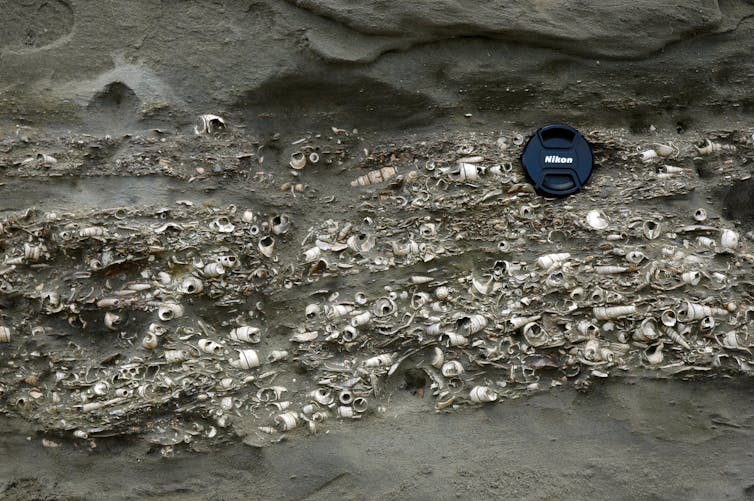
To fill this gap and improve our understanding of extinction in the marine realm, we can turn to the countless “natural experiments” recorded by long-extinct fossil species.
Using fossils, we can identify which particular subsets of marine invertebrates have been most vulnerable to extinction in the past and, therefore, might be at particular risk of future extinction. In this way, we don’t need to wait until species have gone extinct to figure out which are most vulnerable.

James Crampton, CC BY-SA
The importance of New Zealand’s data
New Zealand’s geographic isolation and highly endemic marine fauna mean we are studying a “closed” system. Species have been “captive” and unable simply to move elsewhere when the going got tough.
Both New Zealand’s living and fossil marine faunas are among the best-known on the planet. This gives us rich and large datasets to analyse.
This captive and well-documented marine fauna gives New Zealand scientists the potential to explore the drivers of extinction risk in ways that are relevant globally.
The shellfish (molluscs) are the most abundant and important (by biomass) group of fossil marine invertebrates available for study. They provide a valuable proxy for bottom-dwelling marine animals in general.
Our previous work on New Zealand fossil molluscs suggested their extinction risk was related to their geographic range, body size and position on or within the seafloor sediment, among other factors.
Our current research extends this work to produce extinction predictions for different types of molluscs into the future, using climate models to simulate the next few centuries. This is work in progress and there is so much more to learn about marine extinction risk from New Zealand’s wonderful fossil record.
Are we entering a sixth mass extinction?
Debate about this question is perhaps a distraction.
It is methodologically difficult to place current and future extinctions into the context of past Earth-changing mass extinctions. This is because modern extinction concerns focus on land species and those that are already rare, whereas the fossil record is dominated by the histories of common marine organisms.
The modern extinction rate is also unconstrained. We have no idea how quickly future extinctions will happen.
Will a threatened species become extinct in a few decades (like the passenger pigeon) or will it persist in low abundance for thousands of years, or longer, like the tuatara?
Leaving these questions to one side, recent research by myself and colleagues has shown that at least some past mass extinctions have been defined not by a very high rate of extinction, but by the duration of elevated extinction rate.
This unexpected finding gives us another argument, should we need it, to reduce modern human-driven extinctions as quickly as possible, and to avoid going too far into extinction debt.


