
It is particularly well-known for developing new stop-motion methods that use 3D printing instead of claymation – often printing thousands of distinct facial expressions and armatures to achieve seamless character performances.
Wildwood is in cinemas now.
As many as 24 different 3D-printed faces are used, per second, to bring the characters to life. One scene in the third act brings some 3,000 individual puppets onto a battlefield – an almost unfathomable spectacle.
The story follows Prue, a 13-year-old from Portland, Oregon, who must save her baby brother Mac after he is swept away by a murder of crows and taken to the Impassable Wilderness.
Enchanted forests and familial love
Backed by Nike co-founder Phil Knight, Laika’s previous offerings include Coraline (2009), ParaNorman (2012) and Kubo and the Two Strings (2016). The company excels at marrying stop-motion techniques with CGI and various digital effects.
This is slow, expensive and laborious work – work that few other studios would fund. That’s what makes it special. In the words of director Travis Knight:
Wildwood is a wondrous film. There is tenderness in its small gestures, awe-inspiring set work, and something disarmingly moving in the knowledge that every frame represents a deliberate and painstaking choice.
Above all, it staunchly reaffirms the importance of human creativity in storytelling.
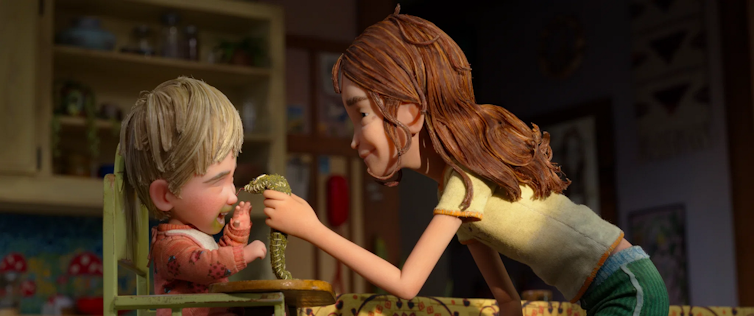
Laika
In the forest, Prue finds and uneasy world on the brink of conflict, populated by talking animals, bandits, mystics and soldiers.
She soon learns her brother was taken by the Dowager Governess, a ruthless and power-hungry ruler who took Mac to complete a dark ritual needed to keep her land. What begins as a rescue becomes something more complex, and Prue discovers an inner strength she never knew she possessed.

Laika
Between its epic battle scenes and complex cinematic shots, you will likely forget you’re watching a stop-motion film.
Yet the hard work has paid off. Wildwood is a triumphant film full of heart and moments of connection – an engaging story for lovers of both puppetry and fantasy.
At the time when entire worlds can be built with the click of a mouse, and videos generated from a prompt, choosing to make a stop-motion film feels like a quiet act of rebellion.
Materials and making
Laika Studios’ latest stop-motion offering is Wildwood, a project that took an extraordinary 16 years to complete. That’s a long time, even by stop-motion standards (most of the studio’s stop-motion films took between three and six years to develop).
From concept artists, to prop makers, production designers, costume designers and animators, a broad range of disciplines come together to produce the expansive fictional world.
Read more:
A century in motion: how stop-motion films went from obscure ‘creature features’ to winning Oscars
From the Forbidden Forest of Harry Potter, to Narnia, to J.R.R. Tolkien’s Middle Earth, Wildwood adds to a long tradition of fantastical stories set in the enchanted forest.
Rated PG-13, Wildwood is family-friendly, but certainly isn’t aimed exclusively at children. The plot delves into darker themes, with moments of genuine peril and intensity giving the film a more mature edge than its beginning suggests.
Animation has long had the unique ability to transport us to other worlds. But stop motion takes this further, with a level of skill and intentionality that provides a perfect counter to the droning hum of AI slop infecting our feeds.
The film offers a critical perspective humanity’s relationship with, and stewardship of, the natural world. It also examines trauma, familial devotion, and the ways in which powerful figures are driven by grief and ambition.
In Wildwood, these capabilities and creative thinking shine. Each moment of the film encodes thousands of small decisions, made by a team of more than 1,000 creatives.
From the mossy towering trees and dense ferns of the Impassable Wilderness, to the red-roofed turrets and golden statues of the Pittock Mansion, the films environment mixes fantasy landscapes with a kind of Gilded Age-inspired opulence.
Here, the forest becomes a place of learning and coming-of-age. And part of the film’s charm lies in its expansive world-building. Wildwood is a society, with its own politics, geography, customs, and distinct look and feel.


