Key competitors face challenges meeting the region’s needs. Russian gas is heavily sanctioned, Qatari exports have been held hostage in the Strait of Hormuz and US gas export terminals are concentrated on the Gulf Coast, adding 10 extra days in transit to reach Asia compared to shipments from Darwin.
Asia-Pacific governments are looking for reliable partners to ensure energy security.
The world’s top two powers, the United States and China, are jostling to expand their energy exports in the region but in very different ways.
What should this strategy look like? In practice, it would involve working with allies like the United States and Japan to build a regional energy security alliance. This would focus on meeting the region’s immediate energy needs and enable Australia to play a central role in the region’s transition to clean energy. The Quad members’ recent joint statement is a strong start.
Energy insecurity is rife across Asia
Any such alliance cannot simply focus on securing fossil fuel supply to the region. The shift to clean energy transition must be factored into its design.
An alliance like this would give certainty to Indo-Pacific countries such as the Philippines, Thailand and India that Australia and its allies would not prematurely turn off fossil fuel supply.
Despite the Trump administration’s unfavourable views on wind and solar, US battery manufacturing is forecast to increase five-fold.
After Iran closed the Strait of Hormuz, Asia lost 80% of its oil supply and 27% of its natural gas supply. Flow-on impacts to Pacific nations were significant, as these island nations rely heavily on diesel and food imports.
In the short term, this would mean guaranteeing supplies of liquefied natural gas (LNG). In the longer term, green exports such as renewable fuels and battery minerals could form the bedrock of Australia’s energy relationship with Asia.
This is where Australia could step up as a regional energy superpower, rich in both renewables and fossil fuels. Australia could form a new energy security alliance to stabilise regional markets for the long-term.
The deal to end the Iran war doesn’t mean an end to these challenges. This year has shown the risks of relying on Middle Eastern oil and gas producers in a conflict-prone region.
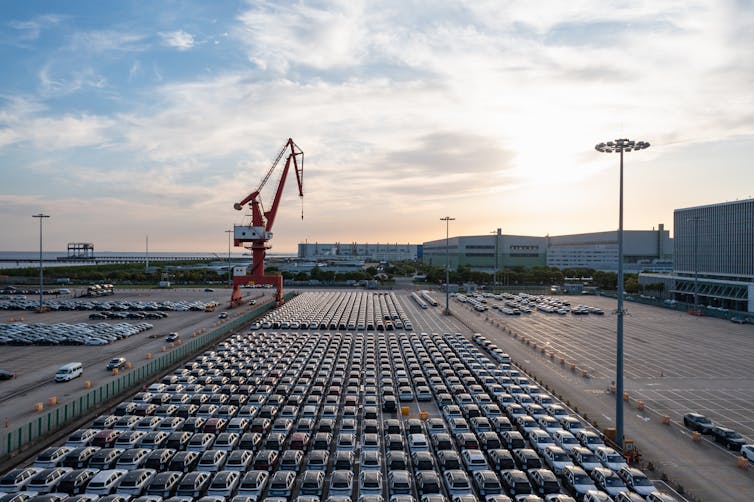
koiguo/Getty
Time for a decisive strategy
China’s response to the Iran conflict has been to double down on electrification and build its reserves of oil. Beijing is also aggressively expanding its exports of electric vehicles, solar panels, batteries and other green tech exports to root out any overseas competition.
The problem is especially acute for Asia and the Pacific, as both regions are highly dependent on imported fuels.
Australia also has some of the greatest clean energy resources in the world, including critical minerals vital to batteries and renewables.
The Iran war has shown the world is not yet ready to wean itself off fossil fuels. Despite very rapid shifts to renewables and clean transport, there are years ahead where gas and oil will remain vital.
These domestic challenges must be balanced with the region’s current need for Australian energy exports.
Australia is poised to take the lead
The United States and Canada would also play a role as major LNG and oil producers. Japan would provide the financing and shipping infrastructure that many smaller Southeast Asian nations cannot. The United States and Japan could also help produce the EVs, batteries and clean tech to drive the region’s transition.
Shifting energy policies and sluggish approval timeframes have left Australia close to a gas shortfall in southern states, slowed the renewable transition and contributed to higher energy costs.
The war between the United States-Israel and Iran triggered a major disruption to fossil fuel supplies.
Without a clear strategy for energy exports, Australia risks becoming a passive spectator.
Australia is the only reliable high-volume LNG exporter in the Asia-Pacific.
Ideally, this alliance should cover the full energy supply chain. That means critical minerals, natural gas, diesel, hydrogen, batteries, data centres and even emerging products such as low-carbon fertilisers.
Meanwhile, the US is pursuing a strategy of “energy dominance”, focused on producing abundant supplies of oil and gas domestically. Washington believes this will deliver affordable energy, win the AI race against China with cheap power and expand energy exports to bind allies closer.
What needs to happen?
This is pragmatic. While Australia is aiming for net zero by 2050, many Asian countries are aiming for 2060 or 2070. They may require fossil fuel supply beyond 2050 – would we rather that supply to come from Australia or Russia?
The risks are twofold. Our role as a coal and LNG exporter could erode as Asian countries look elsewhere to fill their supply gap and we could miss the window of opportunity to grow our clean energy exports.
Energy security is a top priority globally, as governments grapple with the closure of the Strait of Hormuz, an accelerating clean energy transition and surging power demand from AI data centres.
As the region’s most reliable LNG exporter, Australia is well placed to cement its position in the Indo-Pacific’s energy landscape long-term as green exports ramp up. Grabbing this opportunity requires a cohesive strategy, partnering with like-minded allies and fixing domestic challenges.