
It is devotion to this years-long work that animates and defines the lives, art and writing of both Celia Paul and Stephanie Radok.
Now a third panel has arrived. Like its predecessors, Under The Bed: Inventories 2020-2022 draws readers behind the often incomprehensible and obfuscating veil of artist statements pinned to gallery walls. Radok plunges us into a life where art emerges organically out of the everyday stuff: walks with her old dog, gardens, flowers, weeds, “devotion, indulgence, porridge”.
It was a time, she says, in which painting didn’t fill the void. Radok, though, has been a long-term writer. “I didn’t want to be a writer – I was always a writer. I wanted to be a poet, an actor, an artist, but that’s another story.”
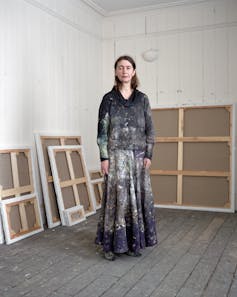
After reading barely a chapter, I had accepted Paul’s premise, because by then I had fallen in love with her: her paint-stained smock and slippers, her flat without furniture or any creature comforts that might encourage visitors.
One woman who has quietly succeeded in living for and with her art over half a century, though not without considerable sacrifice, is the contemporary British artist, and now writer, Celia Paul.
Penguin Random House
In the middle of the night, Radok sings a Cyndi Lauper song to her old dog Eno. She writes eloquently of her vast archive of notebooks, wondering whether she will ever be able to mine them before it is time for them to be destroyed. They are her “palace of memory” and “a garden too, old, rather overgrown, neglected, abandoned, wild”.
Under The Bed is illustrated with Radok’s dry-point etchings, deceptively simple images; several appear to be loving portraits of the companion with the petal-like ears. Letters to Gwen John is liberally sprinkled with reproductions of the work of both the writer and her muse. Even as reproductions, they are mesmerising, and ignite in me a desire to see some of the originals, face-to-face.
Paul’s star appears to be on the rise, with three exhibitions in the United States curated by writer and theatre critic Hilton Als and a major solo exhibition in 2025 at the Victoria Miro Gallery.
Some, such as the German expressionist painter Paula Modersohn-Becker, have even died in the attempt. Having left her husband to pursue her career in Paris, on being persuaded to return to him, Modersohn-Becker became pregnant and died 20 days after giving birth to her first child: she was 31.
Both Stephanie Radok and Celia Paul record quiet lives, but it’s a quietness that hums with the astonishing richness of their creativity.
And having realised late, it makes me question whether I have given as much to it as I could have given. Should I have withheld the keys to my house? But would I even have a house, and within it a room of my own full of comfortable, comforting clutter, if I had instead chosen an austere and solitary life, focused solely on my writing? It doesn’t seem likely.
Everyday art: dogs, flowers, porridge
Paul’s book opens with two portraits set side by side: Self-Portrait with a Letter, 1907, by Gwen John, and Celia Paul’s Self-Portrait, Early Spring, 2020.
I said to the dog, the garden is giving us flowers […] I held them in front of me and […] I was reminded of the artist Paula Modersohn-Becker, who painted herself several times holding flowers in front of her.

Stella Prize
She writes:
As Karl Ove Knausgaard has observed, there is a timelessness to Paul, which is beautifully expressed in her work. So if anyone could forge a communication channel into the past, it’s likely to be her.
In all the years she has lived in London’s Great Russell Street opposite the British Museum (in the flat bought for her by Freud), no one, not even her husband, has been given a key. Her son largely grew up with Paul’s mother in Cambridge, with Paul visiting to spend time with him on weekends.
It seems to say if the natural world appears indifferent to human suffering, it is because suffering belongs to life as the stream belongs to this coastal landscape. The painting also speaks of endurance, and of the way art is pitted against time and loss. Unlike religion, art promises nothing, but its fortress-like beauty bolsters courage.
Towards the end of Paul’s book, in September 2020, she travels with her oldest sister to a cottage in Pembrokeshire, Wales, a place they often stayed as children. With no end to the pandemic in sight, and her husband suffering from cancer she knows he will not survive, she has left London to try to think how to arrange her life.
Wakefield Press
‘I was always a writer’
Review: Letters to Gwen John, Celia Paul (Vintage); Under The Bed, Stephanie Radok (Wakefield Press)
A world away from Paul’s London flat, Adelaide-based artist and writer, Stephanie Radok lives in the old house that was her childhood home. In 2013, the first of her three published memoirs, An Opening: Twelve Love Stories About Art, was longlisted for the inaugural Stella Prize.
Paul’s extraordinary, ascetic, art-focused life is offered up in two brilliant autobiographies, most recently Letters to Gwen John. John (who died in 1939, aged 63) was another British artist who did life tough in pursuit of her art – in her case, in belle epoque Paris.
Wikiart
In the last of the book’s letters, dated November 11 2020, Paul quotes the Irish writer John McGahern: “the best of life is life lived quietly, where nothing happens but our calm journey through the day, where change is imperceptible and the precious life is everything”.
I found the two pathway paintings reproduced in the book to be deeply moving, especially The Stream’s Path to the Sea (2020). While her painting of the cottage and the path leading up to it feels backward-looking – an elegy to a lost and perhaps idyllic childhood – the stream carving its path to the sea, with its omnipotent viewpoint, captures the implacability of time.
She adds that Modersohn-Becker was a friend of poet Rainer Maria Rilke, who wrote a poem for her after her death. “You had just one desire: a years-long work – which was not finished, in spite of all your efforts.”
The palette of soft and complex greys is quite similar in the two works, but while John’s young face is luminously pale, Paul’s older face stares out fearlessly from a fiery aura that surrounds her head and stains her cheeks: a visual reference, perhaps, to that year’s emerging virus threat. John’s painting shows a resolute figure with a clear silhouette, whereas Paul’s outline dissolves into the background in places, making her slight body seem pervious and vulnerable to the outside world.
For this reader, writing to someone who has been dead for decades felt at first too artificial, but Paul acknowledges this from the beginning: “I know you are dead, and that I’m alive, and that no usual communication is possible between us.” But then: “who knows […] whether there might not be some channel by which we can speak to each other, if we only knew how.”
It seemed so artificial to me to draw a person one didn’t know or have any involvement with. Surely art was about recording a personal vision? I needed to work from someone who mattered to me. The person who mattered most to me was my mother.
Notebooks a ‘palace of memory’
One of five siblings, Paul has painted a moving group portrait of her mother and sisters grieving the loss of her father, and, in time, of the sisters mourning their mother’s death.
It had been her intention to make studies of clouds and water, but once at the cottage, what appealed to her most were the area’s grassy, overgrown pathways. Paul writes: “I am struck now by the significance of a path: the one leading to the lonely mountain, the one leading away from the cottage towards the town, the one leading from home, the stream’s path to the sea.”
lists for self-improvement, complaints, dreams (a lot of dreams), visions (quite a few) … and sometimes a poem or something like one lying on its side, half-dead, half-alive, wondering if it will be pulled out and resuscitated or left there.
If Radok’s notebooks are a continuation of the thoughts and meditations in Under The Bed, in which “each day is a story”, I’d like to plead for them to be lodged safely somewhere, perhaps with an embargo of some years on their opening, if that would make her feel more comfortable.
The notebooks contain
Encountering these two women artists on the page may prompt those of us with a creative practice to take stock of our own pathways. As readers, we are fortunate indeed to be offered these open windows into the lives of two exceptional women through their unusually excellent books.
Unstinting artistic devotion
Best known for her portraits, with their uncanny capturing of her subject’s inner lives, she prefers to work from life with people closest to her. As she writes in her first book, Self Portrait (2019):
Wakefield Press
Paul feels a particular connection to Gwen John, and in this book the series of letters she addresses to her act as a slow unravelling of the uncanny similarities between their lives and work. Both women had turbulent relationships with much older, more famous male artists – John with French sculptor Auguste Rodin, and Paul with renowned British painter Lucian Freud. Paul has a son, Frank Paul, with Freud, now aged 41.
For more than three decades, Paul’s mother sat for her twice a week; she travelled from Cambridge to London and climbed the 80 steps to the studio, and when she could no longer manage the stairs, Paul’s younger sister Kate took over as model.
So austere is Paul’s flat that the writer Rachel Cusk, on first visiting her, was suspicious it was an “act” of some kind, and that the rooms Paul actually lived in must be concealed behind sliding doors.
In conversation with artist and writer Edmund de Waal, Paul explains her writing is a recent activity. Both books were a response to grief following the deaths first of her mother and then her husband, Steven Kupfer.
As a writer with my own archive of notebooks and letters, I am in awe of Radok’s certainty and determination. She plans to burn them, even the few volumes she bound herself on a bookbinding course in Canberra: “stiff, stout and strong – they will be quite hard to burn but I will give it a go”.
Radok shakes out ordinary days for us, revealing and sharing the gold dust secreted in their pockets and seams.
Quiet, rich creative lives
The book was followed in 2021 by Becoming a Bird: untold stories about art. Reviewing the latter, Martin Edmond wrote: “it is like the second panel of a diptych”.
The unstinting devotion of these women to their art raises questions for those of us striving to centre a creative practice in our own less-exalted lives. Paul, especially, makes me question the depth of my commitment, makes me wonder why I failed to understand much earlier in life where my creative energy should be focused.
Women artists have always struggled to maintain an art practice as the primary focus of their lives. Going it alone, they’ve needed to contrive ways to survive, or accept that with commitment to a human “other” comes domestic concerns – and very likely, the demands of motherhood.
Paul could be seen as an artist whose singular life is as interesting as her art, but that would devalue her unique ability to reveal through her paintings the inner lives of material things: from the people she loves to a weeping birch on Hampstead Heath, or the impassive facade of the British Museum.
Radok’s book, like Paul’s, is bursting with seductive glimpses of a life spent thinking about and making art. But unlike Paul’s bare rooms, which although chosen and fiercely guarded, hint at a rather haunted loneliness (which Paul admits to) Radok has “a close and constant companion […] He sleeps with his front paws together as if he is praying. His ears are like petals.”


