
As early as December. That’s how soon Russia could put a satellite carrying a nuclear weapon in orbit, according to German media reports.
If the news sounds familiar from headlines past, that’s because it is. In 2024, the United States made a similar allegation, albeit without giving any potential launch window.
These latest reports claim that the satellite, Sputnik-S, was assembled several years ago and is in storage near Moscow.
Intelligence agencies in NATO countries have reportedly shared information about the satellite. This week, the alliance’s secretary general asserted that protecting NATO territory includes keeping it safe from threats to space systems.
Russia’s embassy in Berlin said it “categorically reject[s] all these groundless allegations”. Echoing Moscow’s 2024 denial, it called the reports “propaganda”, adding that Russia “strictly adheres to the fundamental 1967 Outer Space Treaty”.
What is this treaty and what does it say about nuclear weapons? And how could the international community respond or even verify what is on board a satellite?
A lesson on cooperation
The prospect of nuclear weapons off-Earth helped drive negotiations for the treaty invoked by Russia.
During the Cold War, the US and the Soviet Union found common ground on keeping these weapons out of orbit. It was a lesson on cooperation, despite competition and conflict, worth recalling in what is framed as today’s “space race”.
A cornerstone of international space law that prevails to this day, the Outer Space Treaty is also an arms control treaty. Under Article IV, countries undertake not to:
place in orbit around the Earth any objects carrying nuclear weapons or any other kinds of weapons of mass destruction, install such weapons on celestial bodies, or station such weapons in outer space in any other manner.
Placing a nuclear weapon in orbit would itself breach the prohibition, even if it was never detonated. If a detonation did occur, it would breach the Partial Nuclear Test Ban Treaty of 1963, which prohibits nuclear explosions in outer space and in the atmosphere.
Read more:
Too many satellites? Earth’s orbit is on track for a catastrophe – but we can stop it
A nuclear ‘aurora’
No country is known to have ever placed a nuclear weapon in orbit. But there are examples from history of states detonating nuclear weapons off-Earth.
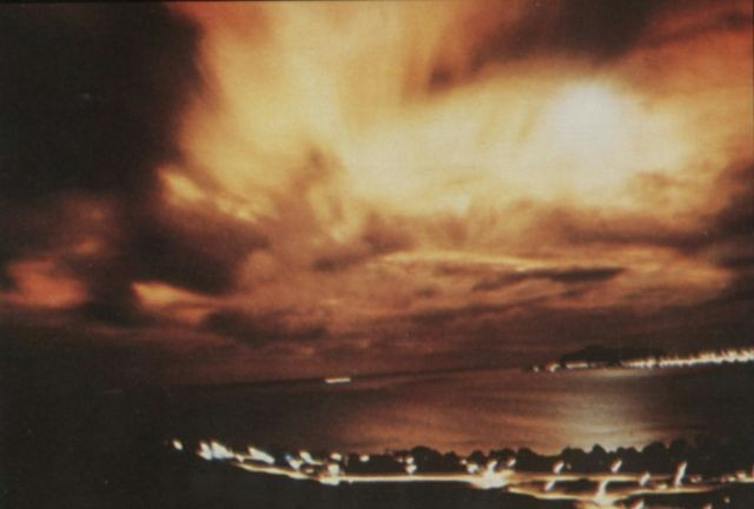
One summer’s night in 1962, people in Hawai’i gazed upward and saw what was, in effect, a nuclear “aurora”. One eyewitness, then a teenager, who was watching with her sibling from a spot overlooking Pearl Harbor, recalled the “exploding sky” and how it later turned “a deep blood red that lingered”.
The US had detonated a nuclear weapon about 400 kilometres above the Pacific Ocean in a classified test code-named Starfish Prime.
The US and the Soviet Union were testing nuclear weapons in space almost in lockstep, each demonstrating its advancing technological capabilities.
Starfish Prime was more than a visual spectacle. Of the 24 satellites in orbit at the time or launched in the following weeks, at least a third suffered damage.
Capnez/Wikimedia
What happens in space is a threat on Earth
Today, the European Space Agency estimates there are about 15,800 functioning satellites in Earth’s orbit.
These satellites support the critical infrastructure we rely on every day, from navigation for transport to timing for banking and telecommunications. Whether we realise it or not, we are all “space citizens”.
Some satellites also support nuclear command, control and communications functions. Others give early warning of missile attacks. Researchers at the Stockholm International Peace Research Institute examine this “space–nuclear nexus”.
During a conflict, leaders might interpret an attack on an early-warning satellite as “a precursor to a nuclear-first strike”. How they respond to that ambiguity could have escalatory risks and significance.
Mitigating the threat through verification
So, what can the global community do to mitigate possible and actual threats of nuclear weapons in space?
As a permanent member of the United Nations Security Council, Russia could veto a resolution responding to the current allegation. Indeed, in 2024, it vetoed a US–Japan draft resolution reaffirming the Article IV prohibition.
The Outer Space Treaty sets out no specific procedure for verifying whether a satellite carries a nuclear weapon, nor does any other international instrument.
Three think tanks working on global and space security have led expert dialogues on how to do so. In their latest joint report, they conclude that verification is “feasible”, albeit challenging, and should be pursued even if “progress may be incremental”.
The report canvasses multiple options. These include nations working together to test ways of detecting a nuclear weapon in orbit, agreeing on how to handle disputed evidence, and inviting pre-launch inspections.
In my research, I have been exploring how nuclear safeguards could advance non-proliferation by verifying nuclear material on board a space object before launch.
As global nuclear arsenals continue to expand and modernise, we must not lose hope of a world one day free of nuclear weapons, an aspiration reflected in the disarmament pillar of the Non-Proliferation Treaty of 1968.
The onus must also rest heavily on states actually capable of launching nuclear-armed satellites, whether or not they face allegations.
The US, China and Russia could discuss verification options in the trilateral dialogue they recently agreed to hold on nuclear risk.
In a strained geopolitical context, a nation’s verbal reassurances alone are unlikely to give the global community the confidence it needs. Nations agreed nearly 60 years ago to keep nuclear weapons out of space.
Verifying whether they keep that commitment will take cooperation, too.


