The cost of wages, venues and materials keep rising with the rest of the economy, while the product of theatre stays stubbornly human. This is what Baumol calls the “cost disease”. Any gain in efficiency comes at the cost of the thing itself.
Queensland Theatre grew its mainstage audience by 5.6% in 2025 and box-office revenue by 42%, compared with 2024 figures – yet recorded a A9,000 deficit in 2025.
Producers are calling on the Australian government for an equivalent of the United Kingdom’s theatre tax-relief scheme. This scheme allows UK theatre companies to claim close to 50% in tax deductions for theatre productions.
Theatre companies also fund work beyond the stage. Queensland Theatre’s Scene Project takes scripts into regional communities for young people to explore acting, directing and storytelling. The project, funded by the Rekindle Foundation, reached almost 4,000 students in 2025.
Growing audiences aren’t enough
The Australian Bureau of Statistics’ 2025 General Social Survey found 22.8% of Australians aged 15 and over had attended a theatre performance in the 12 months prior. That’s more than five million people.
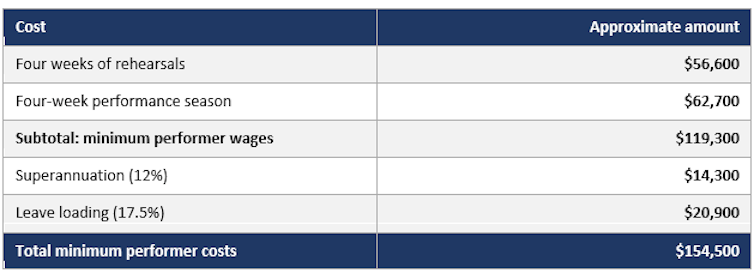
Take a professional company production with 11 actors (a rare luxury for publicly funded theatre companies), four weeks of rehearsals and a four-week season. How much might this cost?
A company could, in theory, “increase productivity” by casting six actors instead of eleven, or trimming a two-hour play down to 90 minutes. But that doesn’t make the same production more efficient; it makes a different production.
This demonstrates how grants and philanthropy can also support education and artist development in a way the box office alone cannot.
Recent cancellations of major musical theatre productions, including Waitress and Beetlejuice, have raised an obvious question: has Australian theatre become too expensive?
A similar incentive for theatre would allow small and not-for-profit companies to benefit, even when they have little or no tax to pay. An incentive set at 30% of eligible expenditure, for example, could return ,000 on a 0,000 production. Having a cap in place would ensure it isn’t swallowed by the biggest commercial shows.
Companies can cut costs, but only so far. Ticket prices can be increased, but that eventually turns the cost problem into an audience problem. And public funding alone is unlikely to solve theatre’s structural economic issues.
What a ticket price doesn’t tell you
Sixty years since Baumol identified the “cost disease”, we still haven’t found a more efficient way to produce theatre without turning it into something it’s not.
Based on minimum wage conditions laid out in the Media Entertainment & Arts Alliance’s (MEAA) Performers’ Collective Agreement 2026, paying the performers alone would set the company back at least 4,400. That’s before they have paid the director, stage manager, designers, technicians and crew.
It’s tempting to blame the audience. As people contend with higher mortgages, rent and bills, a night at the theatre seems easy to cut. But that doesn’t mean everyone has.
Authors provided
The realistic solution is a combination of all three.
A 0 ticket doesn’t buy 0 worth of theatre.
Why don’t the numbers add up?
Over time, most sectors have leveraged manufacturing and technology to raise productivity. Live theatre can’t do this.
Philanthropy also has a role to play, as Queensland Theatre’s Scene Project demonstrates.
On the audience side, the MEAA has proposed a government-funded cultural pass for young people, to the value of up to 0, to help boost theatre attendance.
Theatre producer Suzanne Jones said the latest Australian production of The Book of Mormon cost .5 million just to reach opening night.
Sydney Theatre Company, operating at a much larger scale, generated .75 million in revenue from continuing operations in 2025 – but still had an underlying operational deficit of .76 million. One-off funding and increased fundraising ultimately helped turn this into a 6,418 comprehensive surplus.
We reviewed the 2024 and 2025 financial statements of major theatre companies, and found a striking pattern. Even though more money is coming through the door, companies are still struggling to break even.
So who should pay?
Then there are other costs that audiences rarely see. Venue hire, performance rights, insurance, workers’ compensation, sets, storage, transport, accommodation and marketing all add to the bill – often before anyone knows whether enough people will buy tickets.
For instance, automation has dramatically reduced the labour required to manufacture a car, without changing what a car does. Theatre can’t replicate this.
So if people are still going to the theatre, why is it getting harder to make the numbers work?
None of this removes the need for public funding, and none of it alone solves the problem. But spreading the load is more realistic than expecting theatre companies to simply keep cutting costs. Ultimately, there still needs to be an actor, on a stage, before an audience.
In 1966, economists William Baumol and William Bowen identified a key driver behind theatre’s ongoing financial woes.
Another option could be a refundable theatre production incentive. Australia already provides 30–40% offsets for eligible screen production expenditure.
That’s worth taking seriously, even if a conventional tax deduction does little for companies that are charities or not-for-profits (with little taxable profit).
Bell Shakespeare increased its income from .96 million to .47 million over the same period, but expenses rose faster – from .99 million to .87 million.
Even if a company can get a considerable amount of people through its doors, this doesn’t guarantee it’ll turn a profit.
Companies can use smaller casts and simpler productions, such as Sydney Theatre Company’s recent one-man production of An Iliad. But there is a limit to this. Eventually, cutting costs means losing the very thing we’re trying to save.