
That’s after FIFA made the decision to suspend a one-game ban that had been triggered by a red card against Balogun in the US team’s last match against Bosnia and Herzegovina.
While Ronaldo’s treatment is not unique, what is lacking is a transparent process for the teams to challenge the ban, to preserve both the independence of referees and the integrity of the competition.
Sport has always been deeply political, but this normally occurs off the field of play. If true, reports Trump has used political power to change on-field decisions signal a dangerous precedent and the risk of changing the entire system from a fair game into an exercise of raw influence.
Thank you to FIFA for doing what was right, and reversing a great injustice!
According to multiple media reports – including in The New York Times, The Guardian and Associated Press – this decision came after US President Donald Trump personally called FIFA President Gianni Infantino to lobby for the reversal.
The context around Balogun even being eligible to play for the US – as a child of two Nigerian parents, raised in the United Kingdom – makes Trump’s reported intervention even more startling.
But in a statement, the Royal Belgian Football Association said it was “astonished” by FIFA’s decision. It argued the decision ran counter to the rules of the tournament, where a red card automatically results in a player being suspended for a team’s next match.
Ronaldo received a red card in a World Cup qualifier match in 2025, resulting in a three-match ban. However, the FIFA Disciplinary Committee allowed him to sit out the first of his three match bans last year, and suspended the other two under a one-year probation period.
A controversial red card
The US team, perhaps unsurprisingly, welcomed the ruling, which could significantly improve their chances against Belgium. As did Trump himself, who posted on Truth Social:
In 2001, airline employees prevented Balogun’s mother, seven-months pregnant with him at the time, from flying home to London from New York, where she had been visiting.
The on-field referee, Raphael Claus from Brazil, initially let the play continue unpenalised. However, an experienced video assistant referee (VAR), Juan Ernesto Soto Arévalo from Venezuela, recommended an on-field review for “serious foul play” based on the still images of the ankle bend.
A red card triggers an automatic suspension from the next game, and there is no right to appeal unless there are exceptional circumstances (such as the referee issuing the card to the wrong player).
Balogun was given a red card, despite many critics claiming it was both a VAR overreach, and too harsh a penalty for the tackle.
What’s Article 27?
While FIFA is technically acting within its own rules to change the referee’s decision, political interference destroys the integrity of sport. How can we expect that integrity issues – from fraud, to racism, to match manipulation or sexual assault – will be addressed, to support those with the least power?
In the 64th minute, Balogun stepped on the ankle of Bosnia and Herzegovina defender Tarik Muharemović during what has been described as a normal, 50–50 challenge.
Shortly afterward, Balogun was born in New York – and automatically granted US citizenship under the constitutionally protected “birthright” provisions.
Regardless of whether the referee’s call was “right” in Balogun’s case, political interference in on-field decisions should be robustly resisted to protect the integrity of sport.
Brazil’s prime minister sent an official telegram directly to the FIFA President, arguing Garrincha shouldn’t be penalised. The Chilean president co-signed a petition pleading with FIFA to let Garrincha play. Garrincha’s ban for the final was lifted, and he played a pivotal role in their victory.
Bending the rules
Article 27 has been used before. But importantly, this was done outside of the tournament, to allow one of the most famous names in football to play in the 2026 World Cup: Portugal’s Cristiano Ronaldo.
Sport is fundamentally about the rules of the game. The “spirit of sport” demands these rules are fairly and impartially applied.
In a stroke of irony, President Trump’s executive order ending birthright citizenship was struck down by the US Supreme Court only days before Balogun’s goal helped the US defeat Bosnia and Herzegovina.
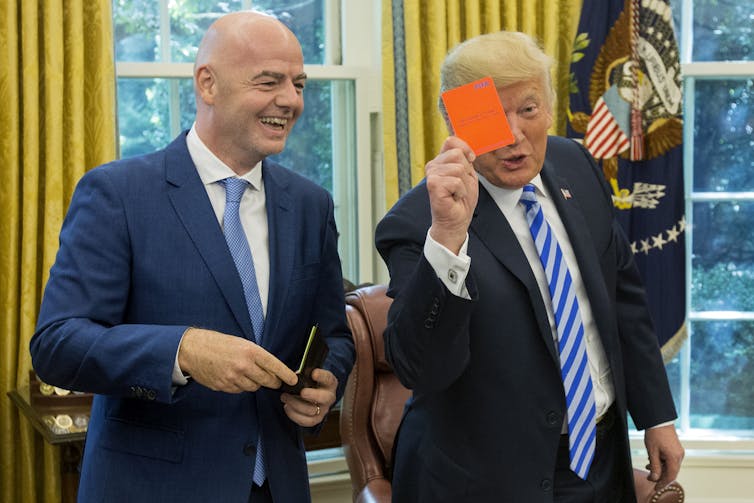
Michael Reynolds/EPA
An American by ‘accident’
United States star striker Folarin Balogun will join the US men’s national team on Monday night (Tuesday morning AEST) as they face Belgium in the FIFA World Cup Round of 16.
There is even precedent in football, before red cards led to an automatic one-game ban. In 1962, Brazilian star Garrincha was given a red card in the men’s World Cup semi-final against Chile.
International sport is not immune from changing its own rules – even mid-tournament – to create a “fair” outcome (that is, to benefit the star athlete who can draw fans). Think of the “wild cards” in tennis and athletics that override selection requirements.
The association said it was investigating “all potential options”, which presumably includes legal action.
The spirit of the game
Before he was sent off with a red card, Balogun had scored the US team’s first goal of the match, ultimately helping them secure a 2–0 victory over Bosnia and Herzegovina in the Round of 32.
In its decision to allow Balogun to play against Belgium, FIFA has invoked Article 27 of its Disciplinary Code. This allows FIFA to fully or partially suspend a disciplinary measure.


