
Increasingly, people in poverty have challenged the presumption of academics and community sector advocates to mediate their perspectives, using digital platforms, social media accounts and publishing ventures to communicate their direct experiences, embedded knowledges and political demands directly to audiences. The persistent ethical dilemmas anthropologists and journalists must wrestle with, in terms of representing others’ lives, have become more heightened still.
In an essay for Aeon, US journalist Sarah Smarsh calls them “poor teeth”. She writes:
Teeth are one of the most visible markers of poverty: structural circumstances that are individually borne.
The late Barbara Ehrenreich supplied a short, generous foreword. She declared herself “waiting for this book” since the publication of her 2001 classic, Nickel and Dimed.
A recent book memorialising the victims of the UK system includes details of a 57-year-old man found dead in his flat. His relatives discovered the lid of a shoebox in his cupboard holding two large molars and a pair of pliers.
Left untreated, dental emergencies can result in hospital visits. Or worse.
Often, bad teeth are blamed solely on the habits and choices of their owners, and for the poor therein lies an undue shaming […] Poor teeth […] beget not just shame but more poorness: people with bad teeth have a harder time getting jobs and other opportunities.
The storytellers in this book found their voices in workshops run across Western Sydney by Sweatshop Literacy Movement, and they write from direct experience.
Peter Breadon, the institute’s health program director, argues that Australia’s public dental system is “underfunded” and “overwhelmed”.
* This is an edited extract, republished with permission, from Griffith Review 91: On the Money, edited by Carody Culver.
In a voice that is direct, sassy, frustrated and funny, Tirado writes about the sex lives of poor people, the costly burdens of poverty (such as late payment fees), her coping mechanisms, the enjoyment she derives from smoking – and about teeth.
In the age of “whitened, straightened, veneered smiles”, the distance between ruined poor teeth and healthy, wealthy teeth is growing.
Published in 2014, Linda Tirado’s Hand to Mouth documents her experiences of being poor, working low-wage, unstable jobs and raising her two children with her husband, who shares her precarious position in the US labour market.
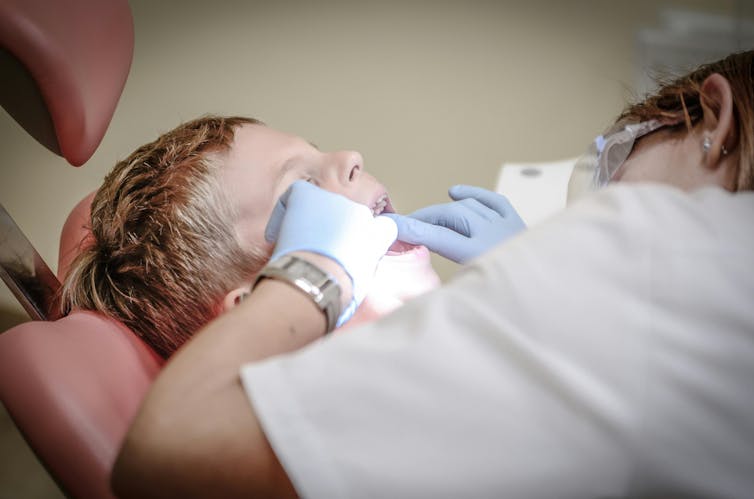
Pixabay/Pexels, CC BY
Speakers addressing the protest were on JobSeeker and the Disability Support Pension. They described their struggles to exist on miserly income support payments and shared their frustration about the hope Albanese’s election seemed at first to represent – hope that was by then fading.
At this protest, I met a JobSeeker recipient who was probably in her late fifties or early sixties. Fraser-era hostility to “dole bludgers” in Australia revolved around a masculine image of workshy youth. Today, researchers describe a JobSeeker recipient as “likely to be older, to be a woman and importantly to have […] a chronic illness or disabilities”.
“Dental into Medicare” was a key Greens policy in the 2025 federal election campaign. While this commitment to expanded coverage has stimulated public attention to the question of teeth and poverty in recent years, Grattan Institute researchers stated in late 2024 that “more than two million Australians avoid dental care because of the cost” and that “more than four in ten adults usually wait more than a year before seeing a dental professional”.
In the picture, her mouth is clamped tight. I admit I had noticed her chipped teeth.
Teeth are central to one especially compelling contribution.
Read more:
Why isn’t dental included in Medicare? It’s time to change this – here’s how
I liked her hand-painted sign, “welfare not warefare”, and took a photo.
In July 2025, the ABC reported that around a third of Australians are eligible for free or low-cost public dental services.

NewSouth Books
The United Kingdom’s intensely conditional welfare system imposes a strict “work capability assessment” in a bid to limit access to disability benefits, as does Australia’s through a similar assessment tool.
The book’s title has a clever double meaning: it’s about how fragile day-by-day existence is but also speaks to the shame surrounding poor teeth, which a hand shielding the mouth attempts to hide.
These services receive some Commonwealth funding but are provided by state and territory governments. The ABC obtained data showing that while average wait time varies across states and territories, in some cases people have waited years to access dental care.
Ehrenreich contrasted her “brief attempt” to subsist on low-wage service and retail jobs with Tirado’s authentic dispatches from impoverished America, lending weight to the valorisation of experiential accounts of poverty over journalistic or scholarly perspectives.
Tirado’s book began life as a post on an online forum she was reading to unwind after a “particularly gruelling shift” at one of her two jobs. Someone posted the question: “Why do poor people do things that seem so self-destructive?” Tirado’s extended response went viral; eventually, she was approached to write a book.
In the lead-up to the 2023 Budget, I attended a protest at Albanese’s electoral office. I went in solidarity: the protest was organised by the Australian Unemployed Workers’ Union.
This is also the premise of the 2024 Australian collection Povo.
“Plot twist!”, Victor Guan Yi Zhou’s story, revolves around the narrator’s tooth
gems, which he takes every opportunity to flash.
I chatted with this woman about the two days a week she spends kneeling in the bush, tugging out weeds to fulfil her “mutual obligations”, the signature measure of the conditional welfare state.
Ehrenreich declared herself an outsider to the topic of contemporary poverty, Tirado the “real thing”. She concluded in her foreword, “But let me get out of the way now. She can tell this story better than I can.”
Despite some marginal improvements to the JobSeeker payment over the past few years, Australia’s payment levels still remain below the poverty line.
In 1970s Australia, when Medicare’s predecessor was designed, dental care was left out. Since 2014, the Child Dental Benefits Schedule has enabled children up to 17 years of age to access free dental care at most private clinics if they’re eligible for Medicare and part of a family that receives certain Australian Government payments.
Got them at a salon… right after Mum and Dad kicked me out. Four of them. Two on the top canines. Two on each incisor. Crystal Swarovski. 0 all up. Each gem will help me manifest my dreams.


