
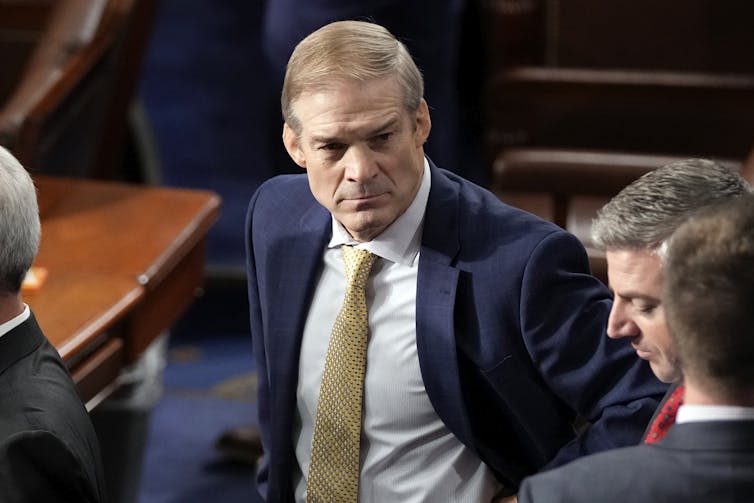
Jordan, the committee’s chair, is a member of the House Freedom Caucus: a formal group of around 45 mostly libertarian conservatives in the Republican Party in the House.
While it seems an unusual move, censorship has grown into a hot-button issue in the United States. Inman Grant finds herself at the centre of a perfect storm of rhetoric, politicking and fierce American individualism.
The position of the House Judiciary Committee does not represent American foreign policy. Jordan, however, is an influential member of Congress and generally friendly with Trump. Jordan’s advocacy may come to impact Trump’s foreign policy, but for the time being, Inman Grant doesn’t have too much to worry about.
The caucus does not necessarily represent the views of most Republicans. It has often been in conflict with House Republican leadership.
The issue of internet censorship is fraught in US politics. At the height of the COVID pandemic, this issue became even more heated and controversial.
On his first full day in office this year, President Donald Trump signed an executive order banning government from censoring social media.
Does she have to testify?
The people who run these companies have generally made a point of getting along with Trump and his administration. They are often seen funding his initiatives and supporting his policies.
Because VPN (virtual private network) technology can allow individual users to escape national restrictions, some foreign governments have asked American companies to take down all posts globally on a certain topic.
Of course, many of the large social media platforms and internet technology companies are American (X, Meta, Google and Amazon, among others).
But the US House Committee on the Judiciary has asked her to appear before it to testify about laws governing the internet.
Mounting cynicism
This is what Inman Grant did in the commission’s case against X, owned by former Trump administration figurehead Elon Musk. The commission wanted video of Wakeley church stabbing in Sydney removed everywhere, not just in Australia. eSafety ultimately dropped the case in 2024.
While there certainly has been a lot of disinformation regarding COVID, the policies of and information from the US government itself during the pandemic have been widely criticised as ineffective or wrong-headed.
Chair of the committee, Republican Jim Jordan, was blunt in his request. In a letter to the commissioner, he wrote:
The backlash from Americans against any kind of censorship has at least two sources. The first the generalised resistance to taking any kind of direction from the government.
The idea that their own government would censor their social media posts – no matter how wrong that post might be on the facts or how counterproductive to the public interest – is anathema to many Americans.
For all the attention she’s been getting, Inman Grant probably didn’t expect any of it to come from a foreign government committee, calling her to answer for a so-called “censorship regime”.
Read more:
Elon Musk vs Australia: global content take-down orders can harm the internet if adopted widely
Alex Brandon/AP
Americans don’t want to be told “no” by their government. Whether it’s guns, drugs, gambling, abortion, gay marriage or even seatbelts, Americans don’t want to be told what to do (although after a few years of clever advocacy, Americans accepted the need to wear seatbelts).
as a primary enforcer of Australia’s OSA [Online Safety Act] and noted zealot for global take-downs, you are uniquely positioned to provide information about the law’s free speech implications […]
The committee has no jurisdiction over the activities of the Australian government. Indeed, it does not even have jurisdiction over US-Australian diplomatic relations, which are the provenance of the House Foreign Affairs Committee.
Ghosts of disputes past
No doubt they also would have done this if Kamala Harris had won the presidency.
The confusing politics and fraught policies from the pandemic era have made many Americans – particularly represented by the Freedom Caucus – much more sceptical of government actions generally.
These sorts of requests, if granted, affect Americans because they wouldn’t have access to those posts. Libertarians in particular do not react well to this possibility, and that means it won’t land well with Congress.
Second, the backlash against the US government, specifically for actions taken during the COVID pandemic, has been fairly broad. Americans have criticised mask mandates, social distancing, working from home, and other measures taken to reduce exposure to the coronavirus.
In the lead-up to the much-discussed social media ban taking effect, Australian eSafety Commissioner Julie Inman Grant is often in the headlines.
It’s against this backdrop that politicians like Jordan cast a wide net in the quest against censorship, real and imagined.
The Judiciary Committee can call anyone it wants to come and testify at a hearing, but potential witnesses outside the US cannot be compelled to do so. This means Inman Grant can decide whether she wants to appear.
Jordan cites this case in his letter to the commissioner. It clearly struck a sour note.
Many Americans were very upset to learn the Biden administration worked with Facebook to censor posts about the pandemic. Facebook Chief Executive Mark Zuckerberg, who testified before the Judiciary Committee about this issue last year, has vowed his company would never do so again.


