Berkshire Hathaway’s latest quarterly filing reveals the company accumulated a US.3 billion stake in Alphabet over the September quarter.
By contrast, newer “megacaps” like Nvidia may struggle in a downturn.
The size of the investment suggests a strategic decision – especially as the same filing showed Berkshire had significantly sold down its massive Apple position. (Apple remains Berkshire’s single largest stock holding, currently worth about US billion.)
Over the past week, news broke that tech billionaire Peter Thiel’s hedge fund had sold its entire stake in Nvidia in the third quarter of 2025 – more than half a million shares, worth around $US100 million.
Nvidia stocks were up more than 5% to $US196 in after-hours trading immediately following the results.
Over the years, those advantages have acted like alligators in Google’s moat, keeping competitors at bay.
Buffett’s new stake in Google
But that framing misunderstands Buffett’s investment philosophy and the nature of Google’s business.
Just weeks ago, Nvidia became the first company valued at more than $US5 trillion – surpassing others in the “magnificent seven” tech companies: Alphabet (owner of Google), Amazon, Apple, Tesla, Meta (owner of Facebook, Instagram and Whatsapp) and Microsoft.
But with its rivers of online advertising gold, experience back to the dawn of the commercial internet, and capacity to use its platforms to nurture new habits among its vast user base, Alphabet is far from a bad bet.
But establishing that business model wasn’t easy. Google had to weave its way through pre-internet intellectual property law and global anxiety about change.
Buffett’s record of picking winners with ‘moats’
The search giant has fended off actions over copyright and trademarks and managed international regulatory attention, while protecting its brand from scandals.
Yet he has long expressed scepticism toward technology businesses. He also has form in getting big tech bets wrong, most notably his underwhelming investment in IBM a decade ago.
Berkshire Hathaway likely sees Google’s track record in these areas as an advantage rivals cannot easily copy.
Buffett is about to step down as Berkshire’s chief executive. Analysts are speculating this investment may offer a pre-retirement clue about where durable profits in the digital economy could come from.
Google won the search engine wars of the late 1990s because it excelled in two key areas: reducing search cost and navigating the law.
Perhaps the genius of Berkshire’s investment is recognising that if the AI bubble bursts, it could bring down some of the “magnificent seven” tech leaders – but perhaps not its most durable members.
Two alligators in Google’s moat
New tech, such as “agentic shopping” or “recommender systems”, can increasingly bypass search altogether.
His firm’s latest move signals they see Google’s moat as widening in the generative-AI era.
Google Ads now brings in tens of billions of dollars a year for Alphabet.
Joi Ito/Wikimedia Commons, CC BY
Based in Omaha, Nebraska in the United States, Berkshire Hathaway is a global investing giant, led for decades by 95-year-old veteran Warren Buffett.
Buffett has picked many winners over the decades, from American Express to Coca Cola.
Consumer-facing giants like Google and Apple would probably weather an AI crash well. Google’s core advertising business sailed through the global financial crisis of 2008, the COVID crash, and the inflationary bear market of 2022.
But in that same quarter, an even more famous billionaire’s firm made a surprise bet on Alphabet, signalling confidence in Google’s ability to profit from the AI era.
These business superpowers will matter as generative AI mutates how we search and brings a new wave of scrutiny over intellectual property.
Disclaimer: This article provides general information only and does not take into account your personal objectives, financial situation, or needs. It is not intended as financial advice. All investments carry risk.
What if the AI bubble bursts?
The better than expected results calmed global investors’ jitters following a tumultuous week for Nvidia and broader worries about the artificial intelligence (AI) bubble bursting.
The world’s most valuable publicly listed company, US microchip maker Nvidia, has reported record $US57 billion ($A88 billion) revenue in the third quarter of 2025, beating Wall Street estimates. The chipmaker said revenue will rise again to $US65 billion in the last part of the year.
Google’s brand, like Buffett, could just get old. Younger people are using search engines less, with more using AI or social media to get their answers.
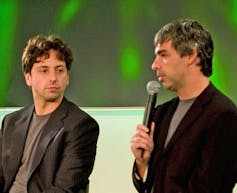
Company founders Sergey Brin and Larry Page started with a revolutionary search algorithm. But the real innovation was the business model that followed: giving away search for free, then auctioning off highly targeted advertising beside the results.
Plenty could still go wrong
Buffett is not late to AI. He is doing what he’s always done: betting on a company he believes has an “economic moat”: a built-in advantage that keeps competitors out.
With Peter Thiel and Japan’s richest man Masayoshi Son both recently exiting Nvidia, it may be tempting to think the “Oracle of Omaha” is turning up as the party is ending.
There’s no guarantee Google will be able to capitalise on the new economics of AI, especially with so many ongoing intellectual property and regulatory risks.
Google understood earlier and better than anyone that reducing search cost – the time and effort to find reliable information – was the internet’s core economic opportunity.
Read more:
Could a ‘grey swan’ event bring down the AI revolution? Here are 3 risks we should be preparing for